
Views: 0 Author: Site Editor Publish Time: 2026-07-25 Origin: Site


Standard off-the-shelf enclosures often force engineering compromises. You might sacrifice optimal thermal management, footprint constraints, or environmental protection. Adapting your advanced technology to fit a generic box creates unnecessary risks. For enterprise hardware, industrial controls, and energy storage systems, a tailored structural solution is a strict requirement.
Transitioning to custom metal enclosure manufacturing ensures exact integration. Internal components remain secure. You meet rigorous operational compliance, such as NEMA and IP ratings. This proactive approach prevents premature field failures. It also simplifies your final assembly process.
This guide breaks down the critical evaluation criteria for selecting an OEM fabrication partner. We focus on how integrated welding and coating capabilities dictate product reliability and lifecycle value. You will learn how material selection, automation, and single-source partnerships streamline your entire production strategy.
Material and Precision Alignment: Selecting the right alloy (e.g., custom steel cabinet vs. marine-grade aluminum) and enforcing strict dimensional tolerances dictates assembly speed and field performance.
Process Scalability: A transition from manual to a robotic welding service is critical for achieving consistent weld penetration and lowering unit costs at high volumes.
Surface Protection: An industrial powder coating service is not just aesthetic; multi-stage pre-treatment and specialized coatings are required for long-term corrosion resistance and compliance.
Vendor Consolidation: Partnering with a single-source OEM metal enclosure manufacturer reduces logistical friction, shortens lead times, and centralizes quality accountability.
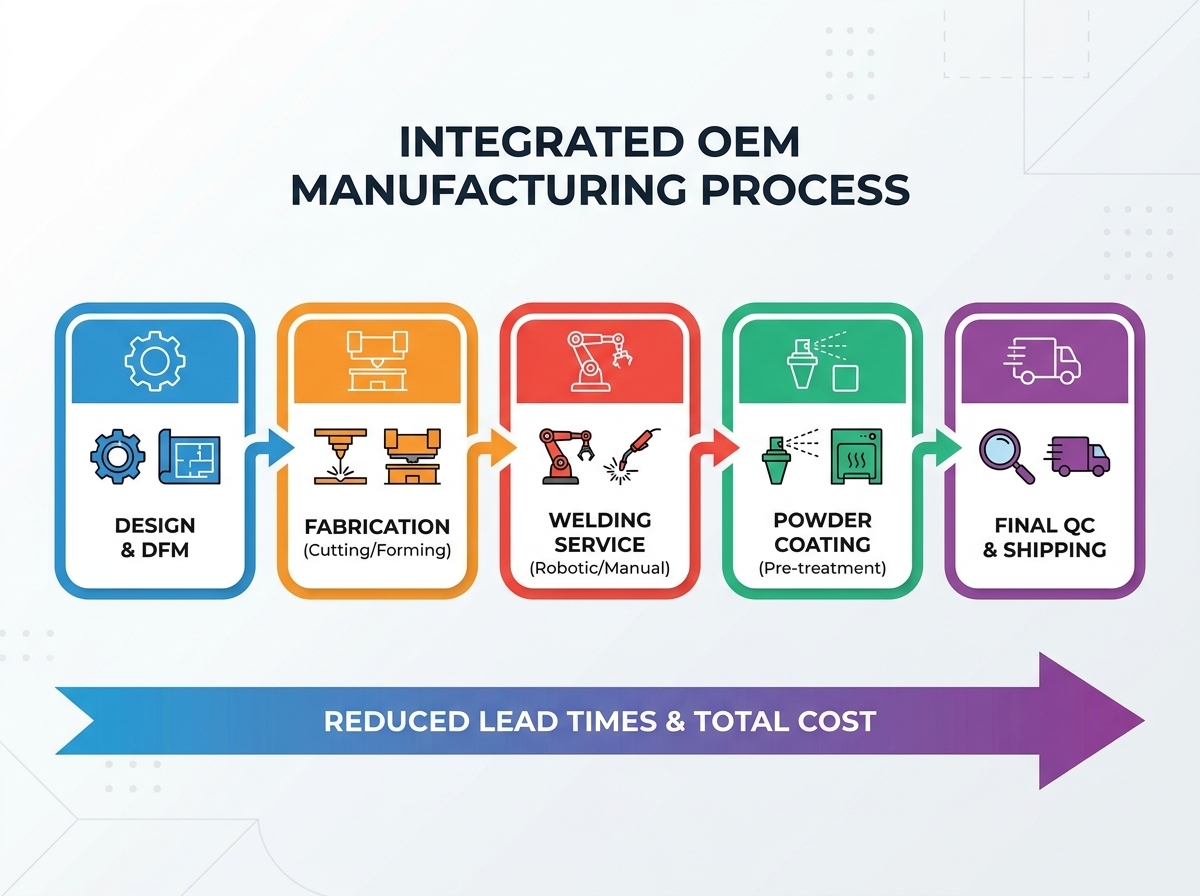
Disjointed supply chains create hidden risks. You might fabricate components at one facility. Then you ship them elsewhere for welding. Finally, a third vendor handles the finishing process. This fragmented approach leads to tolerance stacking errors. Shipping damages increase. Lead times blow out. Partnering with a vertically integrated facility solves this business problem. One team controls the entire tolerance budget from flat sheet to finished product.
Engage manufacturing engineers early in your design phase. They identify costly structural flaws before cutting any metal. Effective DFM reviews optimize bend radii to match available tooling. They reduce secondary operations by designing self-fixturing tabs. Engineers standardise fasteners to simplify assembly. These small adjustments drastically reduce production hours. They also eliminate weak joints.
You must define required operational thresholds upfront. These specifications dictate your joint design, gasketing requirements, and material thickness. Consider the following environmental standards:
NEMA 4/4X: Requires watertight seals against hose-directed water. The "X" mandates extreme corrosion resistance.
NEMA 12: Protects indoor equipment against falling dirt, circulating dust, and non-corrosive dripping liquids.
IP66/67: Demands complete dust ingress protection. IP67 ensures safety during temporary liquid submersion.
Designing for an oem metal enclosure requires strict alignment with these ratings. A slight gap in a welded seam will fail an IP67 test immediately.
High-density electronics generate immense heat. Your design must plan for strategic cutouts, louvering, and active cooling mounts. You must incorporate these features without compromising structural integrity. Fans and vents require specialized filters to maintain NEMA ratings. DFM engineers ensure heat dissipation channels function perfectly alongside structural reinforcements.
Selecting the correct raw material defines your product lifecycle. Engineers must balance structural strength, weight restrictions, and budget limits.
Different environments demand specific metallurgical properties. We evaluate three primary materials for industrial fabrication:
Alloy Type | Key Characteristics | Ideal OEM Applications |
|---|---|---|
Carbon Steel | High structural strength, cost-efficient, requires coating | Indoor server racks, industrial controls, a standard custom steel cabinet |
Stainless Steel (304/316L) | Exceptional corrosion resistance, highly sanitary | Food and beverage processing, medical devices, marine environments |
Aluminum (5052/6061) | High strength-to-weight ratio, natural heat dissipation | Telecom gear, aerospace components, outdoor pole-mounted boxes |
Carbon steel provides excellent rigidity. However, it rusts rapidly without surface protection. Stainless steel 316L contains molybdenum. This addition resists chloride corrosion effectively. Aluminum 5052 bends smoothly without cracking. It remains a top choice for lightweight telecom designs.
Evaluating an OEM's cutting and bending capabilities is crucial. You must verify their laser cutting and CNC press brake technology. Consistent bend angles are non-negotiable. Exact cutouts ensure seamless internal component mounting. Modern fiber lasers cut thick steel rapidly with minimal thermal distortion. CNC press brakes use precision back-gauges. They guarantee every bend aligns perfectly across thousands of units. Poor fabrication precision guarantees external gasketing failures.
Welding defines the structural integrity and ingress protection of your final product. The choice between manual and automated methods depends entirely on your volume, complexity, and compliance needs.
Manual welding remains essential for early prototyping. AWS-certified human expertise handles complex geometries effectively. Experienced welders adapt to minor part variations on the fly. For low-volume, high-mix production runs, human welders provide unmatched flexibility. They maneuver around tight corners where automated torches cannot reach.
Scaling production requires absolute repeatability. A transition to a robotic welding service becomes critical as volumes increase.
Consistency: Automated cells eliminate human variance. They ensure identical weld beads every time. They lock in exact penetration depth. Robots maintain constant travel speeds. This consistency provides strict thermal distortion control across thousands of units.
Scalability and Cost: Automation requires higher initial setup times. Engineers must build custom fixturing and program the flight paths. However, cycle times drop drastically once running. Per-unit labor costs shrink. For high-volume projects, automation secures predictable pricing.
Your chosen method must support structural load requirements. It must also guarantee liquid and dust-tight sealing. Continuous seam welding melts the entire joint. It creates an impenetrable barrier necessary for NEMA 4X enclosures. Stitch welding applies short, spaced welds. It saves time and minimizes heat. However, stitch welding leaves gaps. It requires heavy secondary caulking to achieve any environmental seal.
Bare metal degrades quickly in harsh environments. Applying an industrial surface finish stops oxidation. It also elevates your brand presentation.
Standard liquid paint is often insufficient for heavy-duty hardware. It scratches easily. It chips upon impact. Conversely, powder coating provides superior mechanical properties. The dry powder adheres electrostatically. Ovens then cure the powder into a hard, cross-linked shell. It delivers unmatched impact resistance. It also offers excellent dielectric properties for electrical safety.
A premium powder coating service relies heavily on preparation. Coating over dirty metal guarantees peeling. Automated, multi-stage wash systems are mandatory. They utilize iron phosphate or zirconium baths. These stages strip manufacturing oils. They descale the surface. Ultimately, they create a microscopic texture. This texture creates an optimal bonding surface for the final powder application.
Assess the manufacturer's quality control protocols for finishes. Do not rely on visual inspections alone. Require documented testing procedures.
Salt Spray Testing: ASTM B117 testing exposes coated panels to continuous salt fog. It verifies long-term corrosion resistance.
Cross-Hatch Adhesion: Inspectors score the finish into a grid. They apply specialized tape and pull it off. This tests how strongly the powder bonds to the substrate.
Thickness Measurements: Quality teams use digital gauges. They ensure consistent mil-thickness measurements across all flat surfaces and inside corners.
Advanced environments demand specialized formulations. Outdoor applications require UV-resistant TGIC polyesters. These prevent chalking and fading under direct sunlight. Medical environments utilize anti-microbial coatings. These finishes release silver ions to suppress bacterial growth. Sensitive electronic housings benefit from ESD (electrostatic discharge) safe coatings. They safely dissipate static charges away from internal microprocessors.
Choosing the right fabrication partner determines your long-term success. You need a vendor capable of adapting to your scaling demands.
Prioritize vendors who keep cutting, forming, welding, and coating under one roof. Vertical integration mitigates intellectual property risks. It drastically reduces freight costs. It tightens internal quality loops. If a forming error occurs, the welding department spots it instantly. They correct the CNC program before the next batch runs. Disjointed metal enclosure manufacturing delays this feedback loop by weeks.
Look for verifiable ISO 9001:2015 certifications. This standard proves they operate under strict procedural controls. Request their documented First Article Inspection (FAI) processes. An FAI verifies every dimension matches the engineering print before mass production begins. Demand robust material traceability. If a steel batch proves defective, they must trace it back to the specific mill.
Evaluate their agility. A competent partner executes rapid prototyping efficiently. Prototypes validate form, fit, and function. Once validated, they must offer a transparent transition plan. They should explain how they will scale up. Ask how they transition a manual weldment to an automated cell as your order volumes increase.
Do not select a vendor based solely on a website brochure. Request a facility audit. Virtual tours work, but physical visits reveal their true operational cleanliness. Submit a Mutual Non-Disclosure Agreement (NDA). Send them a 3D CAD model. Evaluate their DFM feedback carefully. Transparent partners will highlight expensive design flaws. They will offer initial quoting transparency, breaking down material, labor, and finishing costs clearly.
Custom manufacturing serves as a foundational investment in your product's reliability and market brand perception.
Shift your evaluation criteria away from just the lowest unit cost. Focus on the highest long-term lifecycle value.
Factor in their ability to deliver reduced defect rates, integrated services, and predictable delivery schedules.
Engage engineering teams early in your product development cycle.
Submit your CAD files for a comprehensive DFM review. Identify cost-saving manufacturing adjustments before you freeze the final design.
A: Realistic timelines typically range from 2 to 6 weeks. This depends entirely on raw material availability and design complexity. Vertically integrated facilities generally deliver faster prototypes. They do not wait on external vendors for cutting or coating stages.
A: Powder coating utilizes a high-temperature baking process. This melts dry powder into a solid, cross-linked barrier. It provides exceptional resistance to chipping, scratching, and oxidation. It outperforms standard liquid paint significantly in harsh industrial environments.
A: We recommend robotic automation when annual volumes exceed a few hundred identical units. It is also required when absolute repeatability is a strict compliance requirement. Automated cells eliminate human variance, ensuring consistent joint strength and identical visual finishes.
A: Yes. The OEM manufactures the physical structure to the exact design specifications required for these ratings. However, the final fully assembled unit must usually undergo independent testing. The end-product owner secures the official certification from recognized laboratories.


