
Views: 0 Author: Site Editor Publish Time: 2026-07-25 Origin: Site


Transitioning a product from CAD design or rapid prototype into scalable production demands serious manufacturing expertise. You must move beyond standard on-demand platforms to find a reliable OEM partner. Disjointed manufacturing introduces severe risks to your supply chain operations. When one facility handles laser cutting and another manages bending and finishing, stack-up tolerances, prolonged lead times, and variable quality control become inevitable. Establishing strict operational standards fixes this disjointed workflow.
This guide establishes clear engineering criteria for evaluating your next manufacturing partner. We explore how to assess capabilities for tight tolerances, strict material compliance, and predictable volume scaling. You will learn how integrated facilities mitigate risk and ensure high repeatability. We also provide actionable steps for vetting equipment tonnage, analyzing precision forming metrics, and verifying secondary processing capabilities.
Integrating laser cutting and CNC bending under one roof reduces handling time and minimizes stack-up tolerance deviations.
A reliable OEM sheet metal manufacturer will provide upfront Design for Manufacturability (DFM) feedback to prevent tooling collisions and springback errors.
Material traceability and ISO-compliant quality control systems are non-negotiable for commercial, medical, and industrial applications.
Evaluating a custom metal fabrication partner requires auditing their equipment tonnage, maximum material thickness, and secondary finishing capabilities.
Splitting fabrication processes across multiple vendors obscures accountability. You might send flat patterns to one shop and ship the cut blanks to another for forming. If a bent part falls out of spec, determining the error origin becomes difficult. Did the initial laser flat pattern lack proper dimensional compensation? Did the press brake operation use the wrong V-die? Finger-pointing replaces problem-solving. This lack of ownership creates severe delays and increases scrap rates.
An effective custom sheet metal fabrication service assumes total responsibility for final dimensional accuracy. They manage the part from initial flat pattern generation to the final formed angle. Centralizing the workflow allows engineers to adjust laser cutting offsets instantly based on real-time press brake feedback. Single-source accountability guarantees tighter control over the entire production lifecycle.
Prototyping prioritizes speed. However, OEM production prioritizes repeatability. The chosen provider must demonstrate massive capacity to lock in machine parameters. They need to standardize tooling setups across multiple production runs. When you scale from 50 units to 5,000 units, the manufacturing partner must deploy rigid standard operating procedures. They must document bend sequences, back-gauge positions, and laser focal lengths to ensure every batch matches the approved first article perfectly.
Common Mistake: Many buyers evaluate vendors solely on their rapid prototyping speed. They fail to audit the vendor's capacity for sustained volume production. Always verify their ability to implement locked manufacturing processes.
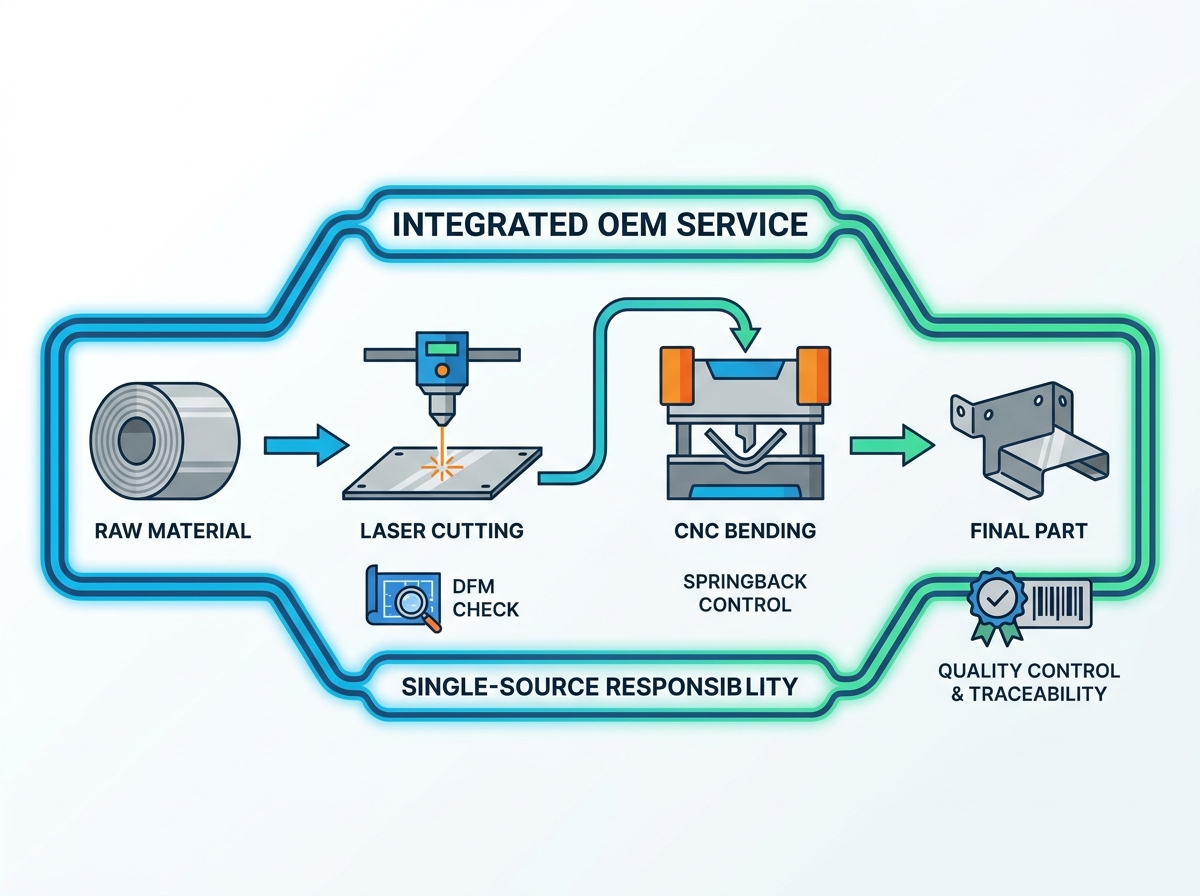
A premier laser cutting service acts as the foundation for all subsequent forming and assembly operations. The quality of the cut dictates the accuracy of the bend. Evaluating this capability requires a deep dive into equipment specifications, material constraints, and edge quality management.
Fabricators typically employ either fiber lasers or CO2 lasers. Each technology serves a distinct purpose. Fiber lasers dominate modern production floors. They offer superior cutting speed and exceptional edge quality for reflective materials like aluminum, brass, and copper. CO2 lasers operate at a different wavelength. They remain highly effective for processing specific thick-plate carbon steel applications or non-metallic substrates.
Laser Technology Comparison Chart
Laser Type | Primary Advantage | Ideal Materials | Speed Profile |
|---|---|---|---|
Fiber Laser | High energy efficiency and pinpoint beam focus. | Aluminum, Stainless Steel, Brass, Copper. | Extremely fast on thin to medium gauges. |
CO2 Laser | Smooth edge finish on very thick plates. | Thick Carbon Steel, non-metals. | Moderate, but highly consistent on heavy plate. |
Material thickness constraints dictate a facility's true capability. Equipment wattage directly impacts maximum cutting depth. Ask vendors for their specific gauge limits.
Standard Material and Thickness Capabilities Table
Material Type | Maximum Typical Thickness | Application Notes |
|---|---|---|
Carbon Steel | Up to 1.00 inch | Varies heavily based on laser wattage. |
Stainless Steel | Up to 0.75 inches | Requires nitrogen assist gas for clean edges. |
Aluminum | Up to 0.50 inches | Highly reflective; requires specialized fiber lasers. |
Standard laser cutting tolerances should hold tight. Expect precision around ± 0.005 inches. Tighter tolerances are achievable depending on material gauge and machine calibration. Edge quality, known as the kerf, also requires strict mitigation. Fabricators must minimize dross, eliminate burrs, and control the heat-affected zone (HAZ). A large HAZ hardens the metal edge. This localized hardening interferes with downstream bending processes and causes micro-fractures during forming.
Transforming flat laser-cut blanks into complex three-dimensional enclosures requires exceptional precision. Multi-axis CNC press brakes ensure high repeatability. You must evaluate the provider's tonnage limits and maximum bend lengths. Large machinery, such as press brakes with 10-foot beds, accommodates oversized enclosures and server racks easily. Insufficient tonnage limits a fabricator's ability to bend thick stainless steel or heavy carbon steel plates.
Managing material behavior separates average shops from expert providers. A professional cnc bending service accounts for material springback during the programming phase. Metal naturally wants to return to its original flat state after bending. Engineers must over-bend the part slightly to achieve the target angle. They also calculate the K-factor to account for material elongation. The metal stretches on the outer radius and compresses on the inner radius. Accurate K-factor calculations guarantee the final formed dimensions match the CAD model.
Tooling availability drastically impacts project costs and timelines. Evaluate standard versus custom tooling.
Standard Tooling: A well-equipped facility utilizes vast libraries of standard V-dies and gooseneck punches. They can form complex geometries without imposing NRE (Non-Recurring Engineering) tooling costs on the buyer.
Custom Tooling: Proprietary bends or extreme radii might require custom-machined dies. Capable partners design and mill these tools in-house to reduce delays.
Segmented Tooling: Essential for box-bending and forming enclosures with multiple deep returns.
A reliable sheet metal fabrication service conducts thorough Design for Manufacturability (DFM) checks prior to bending. They verify minimum flange lengths to ensure the part rests securely on the V-die. They check hole-to-bend distance requirements. If a hole sits too close to the bend line, the material deformation will distort the hole into an oval. Engineers also confirm the presence of proper bend relief cuts to prevent material tearing at the corners.
Raw material sourcing represents the backbone of structural integrity. Top-tier providers guarantee availability of certified raw materials. Common commercial alloys include 5052 and 6061 Aluminum, 304 and 316L Stainless Steel, and Cold Rolled Steel (CRS). Sourcing practices must include Mill Test Reports (MTRs) for critical applications. MTRs provide a documented chemical and physical analysis of the exact metal batch used in your production.
Regulatory compliance protects your product liability. The manufacturing facility must adhere to ISO 9001:2015 standards. This certification proves they maintain a rigid, documented quality management system. If your products incorporate electronics, the provider must ensure RoHS compliance by restricting hazardous substances in their materials and finishes. Strict first-article inspection (FAI) protocols are mandatory. FAI verifies the first part off the production line meets every callout on your 2D print before the remaining batch runs.
Secondary operations transform a bent piece of metal into a fully functional sub-assembly. Evaluate a partner's hardware and assembly capabilities carefully. An experienced custom metal fabrication shop possesses the capacity to install PEM hardware. They insert standoffs, captive nuts, and threaded studs using automated pneumatic presses. This eliminates the need for manual, error-prone hardware insertion.
Localized welding happens post-bending. You need a facility equipped for TIG, MIG, and Spot welding. Spot welding securely joins overlapping flanges without adding excessive heat or filler material. TIG welding delivers clean, aesthetically pleasing joints for visible stainless steel enclosures.
Finally, protective and cosmetic surface finishing finalizes the OEM part. The fabricator should offer access to in-house finishing or utilize strictly vetted local partners. Common finishes include:
Powder Coating: Provides a highly durable, scratch-resistant, and aesthetically pleasing colored finish.
Anodizing: Specifically for aluminum. Increases corrosion resistance and surface hardness while allowing for dye integration.
Zinc Plating: Applies a sacrificial protective layer to carbon steel to prevent rust.
Passivation: A chemical treatment for stainless steel. Removes free iron from the surface to maximize corrosion resistance.
Assessing technical transparency helps you identify true manufacturing partners. A trustworthy provider will challenge your CAD file. They actively look for design flaws. If a design features a physically impossible bend radius for the requested material thickness, they should flag it before cutting metal. For example, attempting a sharp zero-radius bend on 0.25-inch thick aluminum will cause severe cracking. A transparent partner alerts you immediately and proposes a larger radius.
Quoting structures reveal operational maturity. Look for transparent pricing models. An established oem sheet metal manufacturer clearly separates material costs, machine time, and any required tooling or setup fees. Opaque quotes hide inefficiencies. Clear line-item quoting allows you to analyze where your budget goes and make informed design adjustments to reduce machining time.
Lead time reliability determines your time-to-market. Assess the difference between standard lead times and expedited options. Evaluate localized supply chain resilience against the risks of offshoring heavy metal components. Shipping thick steel plates overseas introduces massive freight delays and tariff uncertainties. Regional OEM partners offer better logistical control and facilitate easier onsite quality audits.
Next-Step Actions for Onboarding:
Prepare 3D CAD Files: Export your models in universal formats like STEP or IGES. The fabricator uses these models to calculate precise flat patterns and bending deductions.
Generate 2D Technical Drawings: Create PDF or DXF files calling out critical tolerances, hardware part numbers, and surface finish requirements. 3D models show geometry; 2D prints show rules.
Define Production Scale: Clearly state your estimated Annual Usage (EAU) and initial batch release quantities. This dictates how the manufacturer approaches tooling and material bulk purchasing.
Submit a Comprehensive RFQ: Package the files and submit them for formal review. Request a detailed DFM feedback report alongside the pricing matrix.
Selecting a sheet metal fabrication service represents a long-term supply chain decision. The right partner acts as an extension of your engineering team, optimizing designs for scalable, repeatable production. By carefully evaluating capabilities across both laser cutting and precision forming, you protect your product quality.
Prioritize vendors offering seamless integration between flat-pattern laser cutting and complex CNC bending.
Demand rigid quality control frameworks, including ISO 9001:2015 compliance and rigorous First Article Inspections.
Insist on upfront DFM feedback to eliminate impossible bend radii and mitigate costly tooling collisions.
Verify secondary operational capacities, such as hardware insertion and powder coating, to secure a truly turnkey solution.
Call to Action: Submit your 3D models and 2D prints today for a comprehensive DFM review and production quote.
A: 3D models (STEP or SolidWorks files) are required for precise bending calculations. 2D vector files (DXF) or PDFs are equally necessary for calling out specific tolerances, hardware insertions, and surface finishes. Providing both ensures an accurate and comprehensive quote.
A: While laser cutting can hold tight tolerances of ± 0.005", standard CNC bending tolerances typically range from ± 0.010" to ± 0.015". Angular tolerances usually sit around ± 1 degree. These values heavily depend on material thickness, bend length, and tooling setups.
A: Yes. Short-run prototyping is standard practice. It allows you to validate the CAD design, verify fitment with other components, and lock in the tooling setup before scaling to high-volume production. This mitigates risk and prevents costly full-batch errors.
A: Bending parallel to the material grain increases the risk of cracking, especially in harder materials like aluminum 6061 or thick stainless steel. A competent fabricator nests laser-cut parts so bends occur perpendicular to the grain whenever possible to ensure maximum structural integrity.


