
Views: 0 Author: Site Editor Publish Time: 2026-07-29 Origin: Site


Sheet metal fabrication operations constantly balance the need to scale production throughput against the necessity of maintaining operational flexibility. Fabrication managers face compounding challenges daily on the shop floor. The skilled welder shortage restricts capacity, while clients demand tighter tolerances and expect zero-defect manufacturing across every batch. Addressing these challenges requires moving past the simple debate of man versus machine. Evaluating fabrication methods demands a strategic, data-driven approach based on part mix, production volume, and upstream quality. Integrating Robot Welding changes the entire production dynamic, requiring careful assessment of long-term operational impact and facility readiness.

Throughput vs. Preparation: Robot welding consistently delivers 2-3x faster arc-on times and allows continuous 24/7 duty cycles, but demands rigorous, repeatable part fit-up and expensive fixturing to function effectively.
Flexibility Advantage: Manual welding remains the superior choice for high-mix, low-volume (HMLV) production, custom fabrication, and complex joint access where human adaptability and real-time "hands-on" control are required.
Hidden Implementation Costs: The true cost of robot welding extends beyond the initial CapEx, requiring investments in programming, maintenance, and upstream precision (laser cutting/bending).
Strategic Alignment: The decision hinges on a strict evaluation of production volume, part standardization, and long-term ROI rather than isolated cycle-time metrics.
Table of Contents
An aging workforce heavily impacts the fabrication industry. Certified welders are retiring faster than new professionals enter the field, and this scarcity directly extends production lead times. Fabrication shops struggle to fulfill large orders within tight deadlines when they cannot staff multiple shifts. Capacity constraints force fabrication managers to evaluate automation seriously. Maintaining output requires new strategies when human capital falls short. Automated systems offer a pathway to stabilize production schedules. Relying solely on manual labor introduces unpredictable bottlenecks into the manufacturing pipeline, especially when a single key operator calls in sick or leaves for a competing shop.
To combat this, facilities must look at their current backlog and identify which parts sit in the queue the longest. Often, these are repetitive, high-volume components that tie up skilled hands. By shifting these specific parts to an automated cell, you free up your experienced tradespeople to tackle the complex, high-value assemblies that actually require their expertise. This strategic reallocation of labor is how modern shops survive the talent shortage.
Modern sheet metal fabrication operates under strict quality requirements. Aerospace, automotive, and medical enclosure sectors demand absolute precision. Success criteria for any welding process are non-negotiable. Joints require consistent penetration and minimal porosity. Controlled heat input is vital to prevent warpage in thin-gauge materials like 16-gauge stainless steel or aluminum. Any deviation compromises the structural integrity of the final assembly.
Quality assurance mandates push fabrication facilities to adopt highly repeatable processes. Meeting these stringent standards dictates the choice of welding methodology. When a medical device chassis requires a continuous, leak-proof seam with zero burn-through, the margin for error is nonexistent. You need a process that delivers the exact same heat input and travel speed on part number one as it does on part number one thousand.
Manual MIG (GMAW) and TIG (GTAW) welding form the backbone of current fabrication environments. These processes rely entirely on human ingenuity and tactile feedback. Operators use real-time puddle manipulation to compensate for material inconsistencies. A skilled welder adjusts travel speed and torch angle intuitively. They read the weld pool and react to changing gap conditions instantly.
This adaptability makes manual welding indispensable for complex, variable tasks. Human expertise bridges the gap when upstream processes yield imperfect parts. If a press brake operator slightly under-bends a flange, a human welder can bridge that gap by weaving the torch or adjusting their wire stick-out. They feel the heat radiating from the base metal and know exactly when to back off the pedal to prevent a blowout.
Industrial automated welding systems consist of articulated arms, power sources, wire feeders, and controllers. These systems transition the process from human-controlled variables to programmable parameters. Operators define travel speed, voltage, wire feed rate, and torch angle through code. The machine executes these instructions with absolute fidelity.
Implementing Robot Welding eliminates the physical variations inherent in manual labor. Programmable precision ensures every weld matches the established baseline perfectly. This fixed automation excels in highly standardized production environments. Once dialed in, the system will not deviate, ensuring that the heat-affected zone remains uniform across thousands of cycles.
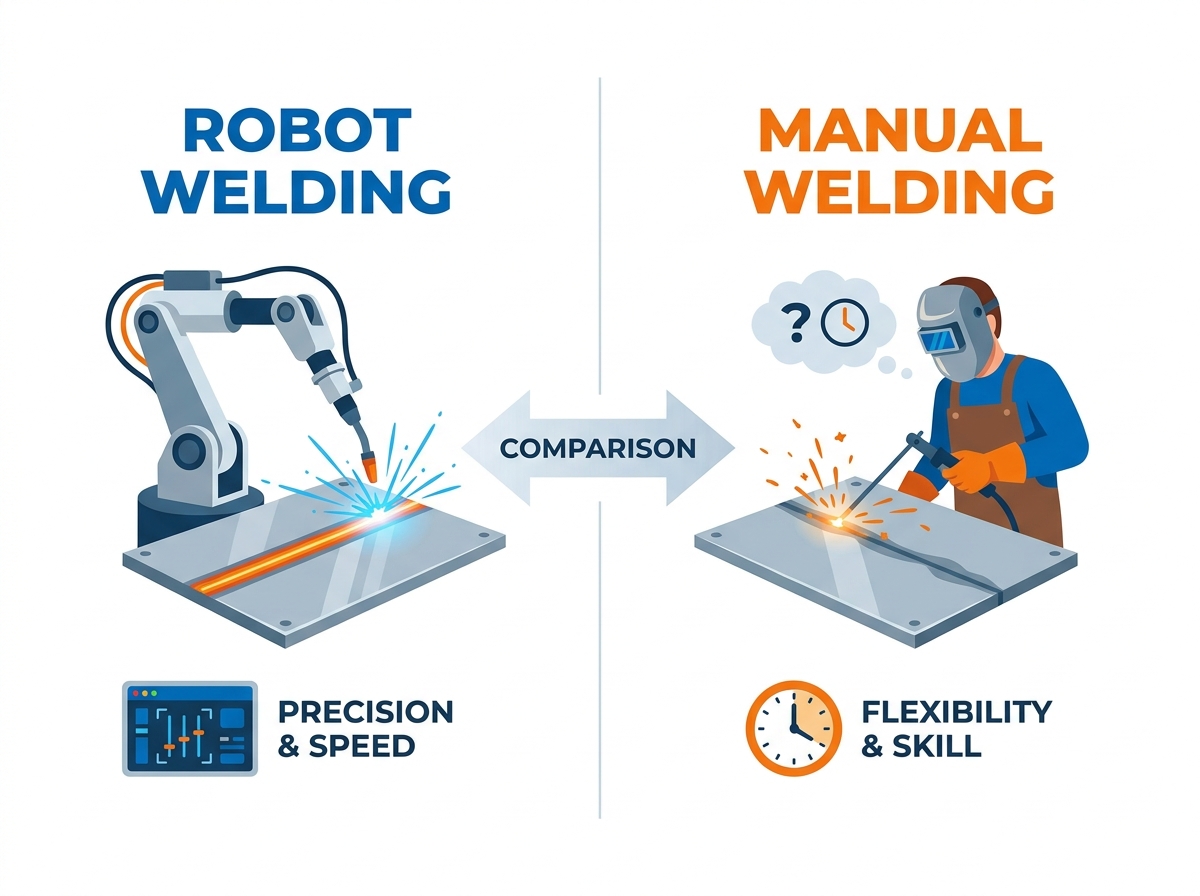
Automated systems deliver a significant speed multiplier. They achieve 2-3x faster continuous arc-on time compared to human operators. Machines do not experience operator fatigue. They maintain peak travel speeds throughout the entire shift. Continuous duty cycles redefine production capabilities. Automated cells offer 24/7 continuous and "lights-out" manufacturing potential.
Human shift work faces strict physical limits. Manual welding cycle times must factor in repositioning, rest periods, and manual slag cleaning or spatter removal. When you measure true throughput, you have to look at the entire shift, not just a single part. A human might weld a single bracket just as fast as a machine, but they cannot sustain that pace for eight hours straight without breaks, stretching, and fatigue-induced slowdowns.
Metric | Manual Welding | Automated Welding |
|---|---|---|
Arc-On Time | 20% - 30% | 75% - 85% |
Travel Speed Consistency | Variable based on fatigue | 100% consistent |
Duty Cycle | Limited by human endurance | Continuous 24/7 capability |
Setup Time per Part | Low (modular clamping) | High (custom fixturing) |
Automated equipment maintains exact torch angles and travel speeds flawlessly. This repeatability leads to uniform bead appearance and predictable penetration. Manual welders provide real-time intervention. They dynamically adjust to gap variances on the fly. Robots rely on advanced seam-tracking technology like laser vision or through-arc sensing to correct path deviations.
Pre-programmed paths cannot intuitively fix sudden material shifts without these advanced sensors. Manual welding inherently introduces variability. This increases the risk of overwelding and burn-through on thin sheet metal. Subsequent rework negatively impacts the production schedule. If a manual operator lays down too much filler metal, someone else has to spend twenty minutes grinding it flush. Automated systems deposit the exact amount of wire required, drastically reducing post-weld grinding and finishing times.
Manual welding offers unmatched ability to pivot between entirely different parts. Welders transition across materials and joint configurations with zero programming downtime. This flexibility dominates high-mix, low-volume (HMLV) environments. Traditional automated systems exhibit significant rigidity in these settings.
Programming and changeovers consume valuable production hours. These setup times can easily negate cycle-time gains achieved during the actual weld. Adaptability remains the strongest argument for retaining skilled human operators in custom fabrication shops. If you run a job shop where you never see the same part twice, hard automation will sit idle while your programmers struggle to keep up with the daily part churn.
Automation drastically reduces human exposure to hazardous environments. It isolates workers from welding fumes, arc radiation, sparks, and extreme heat stress. Manual welding carries inherent long-term ergonomic risks. Operators frequently suffer from repetitive strain injuries (RSI) due to awkward positioning.
Mitigating these risks improves overall facility safety metrics. Automated cells lower associated workers' compensation liabilities. Prioritizing operator health often drives the transition toward automated fabrication solutions. By placing the operator outside a safety cell to load and unload parts, you remove them from the immediate hazard zone, creating a cleaner, safer shop floor environment.
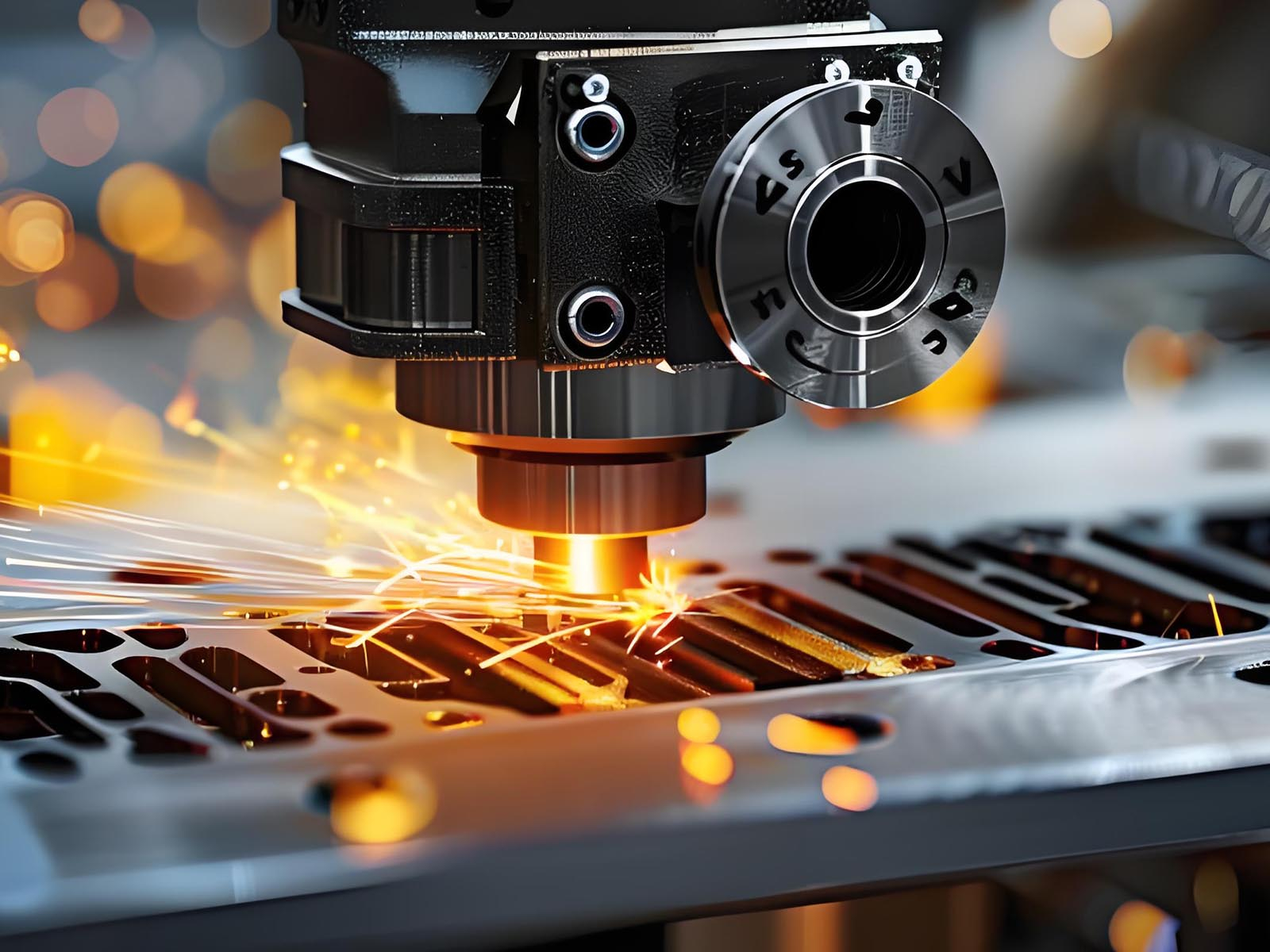
The most critical failure point in welding automation lies in part presentation. Robots cannot easily compensate for poor fit-up or variable gaps. They require sophisticated sensing equipment to handle inconsistencies. Upgrading upstream processes becomes an absolute necessity. Precision laser cutting and highly accurate CNC press brakes must feed the automated cell.
Inconsistent blanks will cause the automated system to produce defective welds. Ensuring tight upstream tolerances requires significant operational discipline and equipment upgrades. If your current press brake bends vary by two degrees from part to part, your automated welding cell will fail. The robot will weld exactly where it was programmed to weld, even if the seam is a quarter-inch away due to a bad bend.
Automated systems require heavy-duty, highly accurate fixturing. These custom-machined fixtures hold sheet metal parts in exact coordinates. Any movement during the cycle ruins the part. Developing these fixtures demands engineering time and resources. Storing bulky robotic fixtures consumes valuable floor space.
Manual welders use modular, adaptable clamping systems. They build temporary jigs quickly using standard shop tools. The rigid tooling requirements of automation present a substantial barrier to entry for many shops. You must design fixtures that not only hold the part perfectly still but also provide enough clearance for the torch neck to access every required joint without collision.
Implementing automation shifts the required labor profile entirely. Facilities replace manual welders with robotic programmers, technicians, and maintenance personnel. This technical overhead requires specialized training and ongoing support. Offline programming (OLP) software helps mitigate downtime.
However, teach-pendant programming for new part introductions still stops production. Maintaining the equipment involves servicing complex servos, controllers, and specialized wire delivery systems. The technical burden shifts from manual dexterity to digital and mechanical troubleshooting. You need staff who understand both the physics of a welding arc and the coordinate geometry of a six-axis robotic arm.
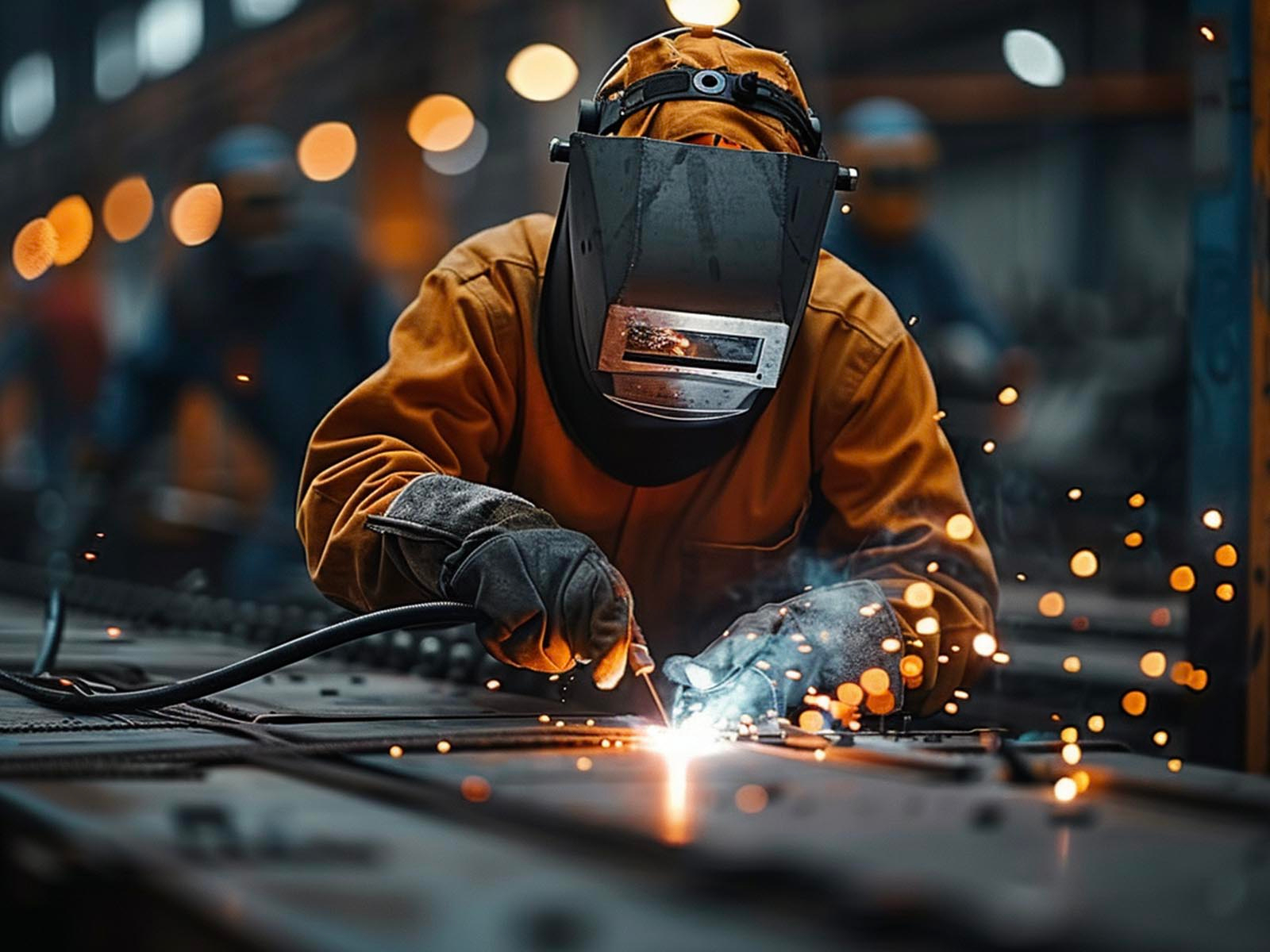
Certain operational profiles strongly favor human expertise. Custom fabrication and repair work require immediate adaptability. Highly complex geometries with limited torch access challenge automated arms. Environments with inconsistent upstream part quality must rely on manual intervention.
Short production runs that do not justify the programming time required for automation.
Shops handling diverse, one-off architectural elements.
Repair operations where the base material condition is unknown or heavily contaminated.
Assemblies requiring complex, out-of-position welds inside tight enclosures.
Manual methods provide the necessary flexibility to tackle unpredictable daily fabrication challenges. A skilled tradesperson can look at a blueprint, grab a few clamps, and have the first article tacked together before a programmer even finishes importing the CAD model into the offline programming software.
Specific production scenarios make automation highly advantageous. Low-mix/high-volume (LMHV) production maximizes the return on programming time. Long runs of standardized parts benefit from continuous arc-on time. Thick-to-thin gauge joining requires exact, repeatable heat control to prevent distortion.
Operations struggling to scale due to severe labor shortages must automate to survive. High-volume automotive or appliance component manufacturing demands the consistency that only automated systems can provide. If you have a contract to deliver five thousand identical brackets every month for the next two years, automation is the only logical path forward.
Collaborative robot (cobot) welding offers a hybrid solution. These systems provide easier programming interfaces and require a smaller facility footprint. They bridge the gap between manual flexibility and industrial robotic consistency. Operators physically guide the cobot arm to teach weld paths quickly.
This intuitive teaching makes HMLV automation much more viable. Mid-volume, high-mix shops utilize cobots to augment their existing workforce. Cobots handle repetitive runs while skilled welders focus on complex, custom assemblies. You can roll a cobot cart up to a heavy welding table, teach it a simple linear weld in five minutes, and let it run a batch of fifty parts while the operator preps the next job.
Choosing between robot welding and manual welding should be based on your production volume, product complexity, quality requirements, and long-term manufacturing goals. By evaluating automation readiness, upstream process stability, and return on investment, manufacturers can select the welding solution that delivers the best balance of efficiency, flexibility, and product quality.
DINGPRECISION specializes in precision sheet metal fabrication, welding, and custom manufacturing solutions for customers across a wide range of industries. Backed by advanced manufacturing equipment, experienced engineering teams, and rigorous quality control systems, the company provides reliable fabrication services that help customers improve production efficiency, maintain consistent quality, and accelerate project delivery.
Before deciding on your welding process, remember to:
Evaluate your production volume and product standardization.
Assess upstream cutting and bending accuracy before implementing automation.
Compare long-term operating costs, productivity, and quality requirements.
Partner with an experienced fabrication manufacturer that provides professional engineering support and scalable manufacturing solutions.
A: Yes, automated systems deliver 2-3x faster arc-on times. They operate continuously without fatigue. However, overall speed depends heavily on programming time and part changeovers. Short runs may actually take longer due to setup requirements.
A: The primary disadvantages include the strict requirement for perfect part fit-up and a lack of flexibility for custom parts. They also require specialized programming knowledge and dedicated, rigid fixturing for every unique assembly.
A: No. Automated systems augment production capacity. Human expertise remains essential for programming, system oversight, complex custom work, and initial part tacking before automated cycles begin.
A: Gaps typically must be controlled within half the diameter of the welding wire. Exceeding this tolerance drastically increases the risk of burn-through or lack of fusion during the automated cycle.
A: Traditional industrial robots struggle in HMLV environments due to extensive programming overhead. However, newer collaborative robot (cobot) systems feature intuitive teaching methods, making HMLV automation increasingly viable.
A: Automated systems precisely control travel speed and heat input. This consistency significantly reduces the heat-affected zone (HAZ). It minimizes warpage far better than inconsistent manual welding techniques.


