
Views: 0 Author: Site Editor Publish Time: 2026-10-12 Origin: Site


Choosing the right material for an outdoor electrical enclosure affects corrosion resistance, impact protection, thermal management, installation cost, and service life. The best option depends on the installation environment, required enclosure rating, internal heat load, and maintenance plan.
Aluminum and stainless steel are common metal options. UV-stabilized polycarbonate and fiberglass-reinforced plastic (FRP) are useful alternatives when electrical insulation, reduced weight, or wireless signal transmission matters. Coated carbon steel and galvanized steel can also be suitable when their corrosion protection matches the environment.
This guide compares the main outdoor electrical enclosure materials and explains how to select the right option for coastal sites, industrial facilities, solar installations, telecommunications equipment, and other outdoor applications.
Table of Contents
Outdoor enclosures face different combinations of environmental stressors. Identify the conditions at the installation site before comparing materials.
UV radiation: Prolonged sunlight can degrade some plastics and protective coatings. Specify materials and finishes designed for the expected exposure.
Moisture and rain: Water can enter through unsuitable seals, joints, cable entries, and mounting interfaces.
Salt spray and chloride exposure: Coastal environments can accelerate corrosion in susceptible metals and damage unsuitable protective finishes.
Industrial chemicals: Cleaning agents, chemical vapors, and process fluids may attack certain metals, coatings, plastics, or gaskets.
Temperature changes: Daily temperature cycles and extreme weather can affect seals, material dimensions, and internal condensation.
Mechanical impact: Public access, nearby machinery, flying debris, and vandalism may require additional impact protection.
A material that performs well in a dry inland location may not be suitable for a coastal or chemical-processing site. Start with the actual exposure conditions rather than choosing a material based on price alone.
Material selection is only one part of enclosure design. The complete enclosure must meet the required protection level.
Rating system | What it evaluates | What to check |
|---|---|---|
IP | Protection against access, solid particles, and water | The specific protection level and applicable test conditions |
NEMA | Enclosure performance under defined environmental conditions | The required enclosure type and any corrosion-resistance requirements |
IK | Resistance to mechanical impact | The specified impact level and tested enclosure configuration |
For example, IP65 and IP66 have different water-jet test requirements, while IP67 addresses temporary immersion under specified test conditions. These ratings should not be treated as interchangeable.
NEMA 4X includes corrosion-resistance requirements in addition to specified enclosure protection. However, the rating cannot be inferred from a material name alone. Confirm the complete enclosure's design, sealing, hardware, and applicable test results.
IK ratings should also match the expected impact risk. Do not assume that every outdoor installation needs IK08, IK09, or IK10. Define the requirement based on the equipment's location and applicable project standards.
Solar radiation can raise the surface and internal temperatures of an outdoor enclosure. Electronic components also generate heat during operation.
Aluminum conducts heat more readily than many other common enclosure materials. This can help transfer heat through the enclosure wall, but the actual internal temperature depends on solar loading, ambient temperature, enclosure size, ventilation, component heat output, and any cooling system.
Non-metallic materials generally provide more thermal insulation than metal. This can reduce heat transfer in some situations, but it may also limit passive heat dissipation from internal components.
Evaluate the complete thermal design rather than selecting a material based on thermal conductivity alone. Depending on the application, the solution may require ventilation, heat exchangers, air conditioning, insulation, or a solar shield.
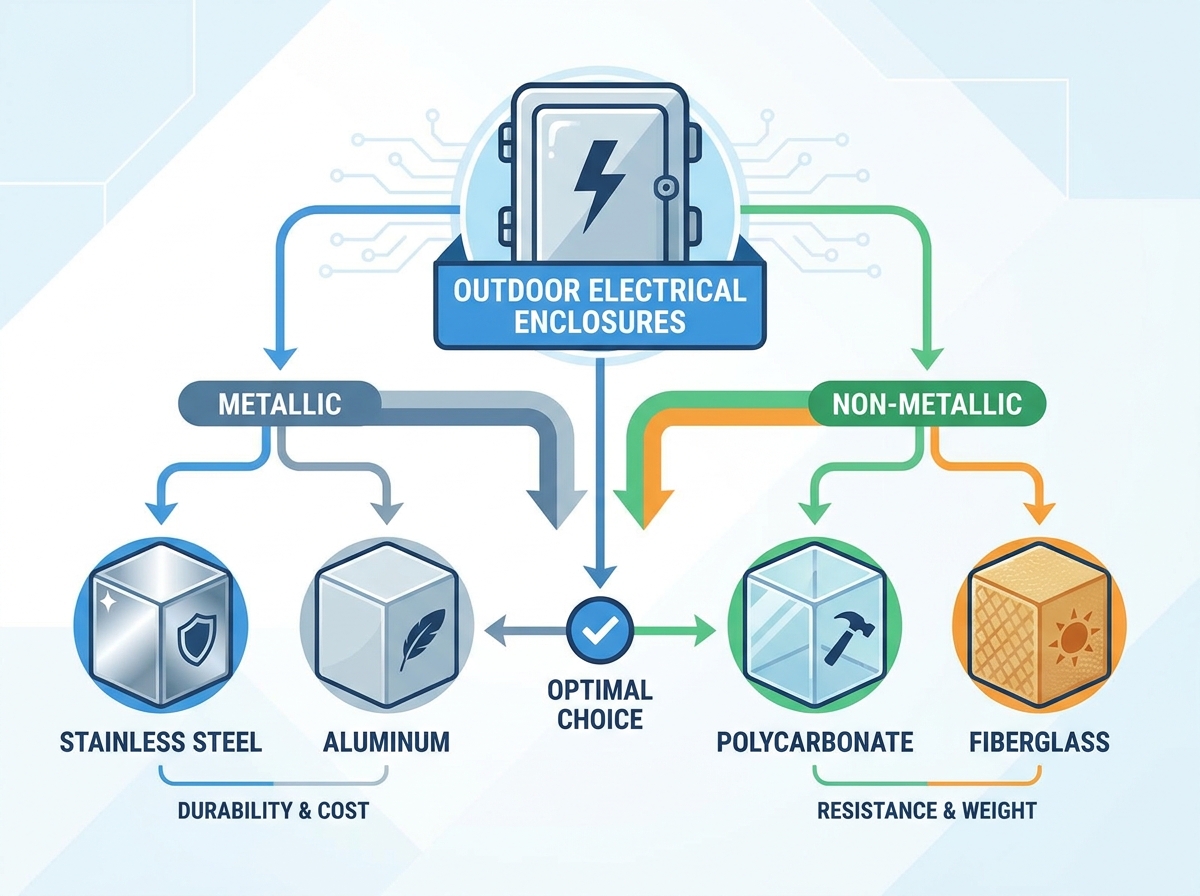
Image placement: Use this image after the environmental and rating considerations to introduce the enclosure material comparison.
Aluminum is a strong candidate for outdoor enclosures when weight reduction and thermal management are priorities.
Its advantages include:
Lower density than steel, which can simplify handling and mounting.
A naturally forming oxide layer that provides corrosion resistance in many environments.
Good thermal conductivity compared with many non-metallic materials.
Compatibility with various fabrication and surface-finishing processes.
Aluminum is commonly considered for telecommunications equipment, lightweight control enclosures, solar equipment, and outdoor electronic housings.
However, aluminum is not immune to corrosion. Strong alkaline environments, certain chemicals, damaged protective finishes, and contact with dissimilar metals can create problems. The alloy, surface treatment, fasteners, and installation conditions should be evaluated together.
For projects requiring custom metal housings, review DINGPRECISION's sheet metal fabrication services to understand its manufacturing and finishing capabilities.
Stainless steel is useful when an enclosure needs corrosion resistance, mechanical durability, or a metallic surface finish.
304 stainless steel is commonly used for general industrial applications and many outdoor environments where its corrosion resistance is sufficient.
316L stainless steel contains molybdenum and generally offers better resistance to chloride-related pitting than 304. It is often considered for coastal installations, marine equipment, and selected chemical-processing environments.
Factor | 304 Stainless Steel | 316L Stainless Steel |
|---|---|---|
General corrosion resistance | Good for many applications | Generally higher resistance in selected aggressive environments |
Chloride exposure | May be susceptible to pitting | Generally more resistant than 304 |
Initial material cost | Usually lower than 316L | Usually higher than 304 |
Typical applications | General industrial enclosures and equipment | Coastal, marine, and selected chemical-exposure applications |
Neither grade is suitable for every environment. High chloride concentrations, elevated temperatures, deposits, and crevices can still cause corrosion. Confirm the material grade against the expected operating conditions.
Stainless steel is also relatively heavy and has lower thermal conductivity than aluminum. Large enclosures may need stronger mounting arrangements, while high-heat applications may require a separate thermal-management solution.
For more information about metal grades and material selection, see the DINGPRECISION material selection guide.
Galvanized steel and coated carbon steel can provide a cost-effective solution when the protective system is suitable for the installation environment.
Galvanized steel uses a zinc coating to help protect the underlying steel from corrosion. Powder-coated carbon steel uses a prepared surface and a protective coating to improve corrosion resistance and appearance.
These materials may suit outdoor electrical cabinets, equipment housings, control panels, and structural enclosures where the exposure conditions are compatible with the specified protection system.
Their long-term performance depends on factors such as:
Coating type, thickness, and adhesion.
Pretreatment and surface cleanliness.
Cut edges, holes, welds, and damaged areas.
Water retention and drainage.
Exposure to salt, chemicals, and temperature cycles.
Inspection and maintenance practices.
A scratch does not mean every coated steel enclosure will immediately fail, but damaged protection can expose the substrate and create a corrosion risk. Design, fabrication, coating quality, and maintenance all matter.
DINGPRECISION describes its surface preparation and powder-coating processes in its guide to industrial powder coating standards and quality control.

Polycarbonate is a lightweight thermoplastic known for its impact resistance and electrical insulation properties. It is often considered for outdoor electronic housings, communication equipment, sensors, and applications that use internal antennas.
Its main advantages include:
No conventional steel rusting.
Good impact resistance for suitable grades and designs.
Electrical insulation.
Lower weight than many metal enclosures.
Potentially better RF transmission than a metal enclosure, depending on frequency and material design.
For outdoor use, specify a grade designed for UV exposure. Standard polycarbonate may discolor, lose impact performance, or develop surface degradation after prolonged sunlight exposure.
Wireless performance should also be verified for the actual application. Antenna frequency, enclosure thickness, pigments, additives, internal components, and nearby metal parts can affect signal performance. Polycarbonate should not be described as completely transparent to every radio frequency.
Check the manufacturer's UV, impact, temperature, and chemical-resistance data before selecting a grade.
Fiberglass-reinforced plastic combines glass fibers with a polymer resin. It can provide good rigidity, electrical insulation, and resistance to many corrosive environments.
FRP is often considered for wastewater facilities, chemical-processing areas, utility installations, and other locations where selected chemicals may damage conventional metals.
Its performance depends on the resin system, reinforcement, surface finish, and exposure conditions. Not every FRP formulation resists every chemical.
Long-term outdoor use also requires attention to UV exposure. Some products use UV-resistant resin or protective surface layers to limit degradation. Follow the manufacturer's guidance for inspection, cleaning, drilling, and repair.
Cutting or drilling FRP can release irritating dust and fibers. Use appropriate tooling, extraction, and personal protective equipment when modifying the enclosure.
PVC and ABS are lightweight plastics used in certain electrical housings and general-purpose products. Their suitability for outdoor service depends on the exact formulation and product rating.
Standard indoor-grade plastics should not automatically be specified for prolonged sunlight, severe temperature changes, or impact-prone locations. UV stabilization, operating temperature, impact performance, chemical compatibility, and enclosure ratings must be checked.
Choose an outdoor-rated product with documented performance rather than assuming all PVC or ABS enclosures are unsuitable—or suitable—for every outdoor application.

The enclosure material alone does not determine weather resistance. Door gaskets, cable glands, joints, hinges, and mounting interfaces also affect the final protection level.
Common gasket options include:
EPDM: Often considered for outdoor weathering, water, and ozone exposure. Confirm chemical compatibility and temperature limits.
Silicone: Useful across a wide temperature range in suitable formulations. Mechanical strength, compression behavior, and chemical compatibility still need review.
Neoprene: Used in some general sealing applications. Its suitability depends on the specific exposure and product specification.
Polyurethane-based sealing systems: May be suitable for certain enclosure designs where continuous sealing and compression performance are required.
Do not select a gasket based only on its generic material name. Check the manufacturer's temperature range, UV and ozone resistance, compression set, chemical compatibility, and installation requirements.
The enclosure must be tested or documented for its intended rating in the final configuration. Changing a gasket, cable gland, fastener, or door design can affect protection performance.
Hardware should be compatible with the enclosure material and installation environment.
When dissimilar metals are connected in the presence of moisture or another electrolyte, galvanic corrosion may occur. For example, a connection between stainless steel hardware and aluminum may require additional consideration, depending on the environment and surface treatments.
Potential mitigation measures include compatible fastener materials, suitable coatings, insulating washers, and appropriate joint design. The right solution depends on the metal combination, electrical contact, exposure, and maintenance requirements.
For coated steel enclosures, consider how drilling, welding, or installing hardware affects the protective finish. Damaged coating may require an approved repair process.
The following table summarizes common selection priorities. It is a screening guide, not a substitute for product specifications or enclosure testing.
Material | Main Advantages | Main Limitations | Typical Applications |
|---|---|---|---|
Aluminum | Lightweight, good thermal conductivity, corrosion resistance in many environments | Can corrode under unsuitable chemical exposure or galvanic contact | Telecommunications, solar equipment, lightweight housings |
304 stainless steel | General corrosion resistance, durable metal construction | Higher weight and cost than many coated-steel options | Industrial equipment and general outdoor enclosures |
316L stainless steel | Improved resistance to chloride-related pitting compared with 304 | Higher material cost; not immune to all corrosion | Coastal and selected marine or chemical environments |
Galvanized steel | Zinc protection with a cost-effective steel substrate | Protection depends on coating integrity and exposure | Outdoor cabinets and industrial housings |
Powder-coated carbon steel | Flexible finishing options and competitive material cost | Coating damage and unsuitable exposure can increase corrosion risk | Protected outdoor installations and general industrial enclosures |
UV-stabilized polycarbonate | Lightweight, insulating, suitable for many wireless applications | UV, temperature, chemical, and impact performance depend on grade | Sensors, communications, and electronic housings |
FRP | Electrical insulation and resistance to many corrosive environments | Resin compatibility, UV exposure, and modification requirements | Utilities, wastewater, and selected chemical facilities |
PVC or ABS | Lightweight and available in various enclosure designs | Outdoor suitability depends on formulation and product rating | Applications where the specific product is rated for the environment |
Use the following steps to narrow the options before requesting a quotation.
Document salt spray, moisture, sunlight, chemicals, temperature extremes, and potential impact. Consider whether the enclosure will be mounted indoors, outdoors, on a pole, near the ground, or inside a larger protective structure.
Identify the required IP or NEMA rating and any IK impact requirement. Verify that the selected enclosure has appropriate supporting documentation or test results.
Estimate the internal heat load and solar exposure. If wireless communication is required, assess antenna placement and enclosure signal performance. Do not assume that a metal enclosure will work with an internal antenna without testing or a suitable antenna arrangement.
Include the material, fabrication, coating, hardware, mounting, maintenance, and expected replacement costs. A low initial purchase price may not be economical if the protection system requires frequent repair.
Check whether the enclosure requires cutouts, cable entries, mounting brackets, welded features, or special surface treatments. These details can affect corrosion protection, sealing, and manufacturing cost.
DINGPRECISION provides sheet metal fabrication, welding, and surface treatment capabilities for industrial enclosures. Review its electrical control and energy storage enclosure applications when evaluating a manufacturing partner.
Before production, review the enclosure drawing, door and gasket design, cable-entry details, hardware compatibility, mounting loads, thermal requirements, and applicable testing.
A material choice should be approved as part of the complete enclosure design, not in isolation.
The best material for an outdoor electrical enclosure depends on the installation environment, required protection ratings, internal heat load, wireless requirements, and maintenance plan.
Aluminum is worth considering when weight and thermal conductivity matter. Stainless steel may suit corrosive or impact-prone environments. Galvanized and powder-coated steel can provide a cost-effective solution when their protection system matches the exposure. UV-stabilized polycarbonate and FRP are useful alternatives when electrical insulation, lower weight, or non-metallic construction is important.
No material guarantees long-term performance on its own. Evaluate the complete enclosure—including its finish, gaskets, hardware, cable entries, mounting, and thermal design—before finalizing the specification.
For custom enclosure fabrication, contact DINGPRECISION to discuss your material requirements, drawings, and manufacturing needs.
There is no universal best material. Aluminum, stainless steel, coated steel, UV-stabilized polycarbonate, and FRP can all be suitable when their properties match the environment and enclosure requirements.
Aluminum is lighter and has higher thermal conductivity. Stainless steel may be preferable when the application requires its particular mechanical and corrosion-resistance properties. The right choice depends on exposure, mounting, heat load, and lifecycle cost.
Yes, when the specific product is designed and rated for outdoor use. Check UV stability, impact resistance, temperature limits, chemical compatibility, and the required enclosure protection rating.
IP ratings classify protection against access, solid particles, and water under specified test conditions. NEMA enclosure types address defined environmental protection requirements, with some types including corrosion resistance. They use different classification systems and should not be treated as directly interchangeable.
Evaluate humidity, temperature changes, and the internal dew point. Depending on the application, suitable measures may include controlled ventilation, pressure-equalization vents, heaters, or active thermal management. Confirm that any added component maintains the required enclosure protection.


