
Views: 0 Author: Site Editor Publish Time: 2026-11-10 Origin: Site


Fiber laser cutting can process carbon steel across a wide range of thicknesses. However, the maximum thickness depends on laser power, steel grade, assist gas, machine configuration, and required edge quality. A machine that can separate a thick plate may not be able to cut it consistently at an acceptable production speed.
For manufacturers, the key question is not only how thick a fiber laser can cut, but also whether it can meet dimensional tolerances, edge-quality requirements, production targets, and cost expectations.
This guide explains the main factors that determine carbon steel cutting thickness and how to evaluate a laser cutting process for real production.
Key takeaways:
Higher laser power generally increases cutting capacity and can improve productivity on thicker plate.
Oxygen is commonly used for carbon steel because its reaction with hot steel adds energy to the cutting process.
Nitrogen can help produce less-oxidized edges, but its suitability depends on thickness, power, gas pressure, and cost.
Maximum severance thickness is not the same as a reliable production thickness.
The best equipment choice depends on total cost per part, not wattage alone.

Table of Contents
There is no single maximum thickness that applies to every fiber laser cutting machine. Cutting capacity depends on several factors working together.
Higher laser power generally allows more energy to reach the cutting zone. This can increase the maximum thickness a machine can separate and improve cutting speed within a suitable operating range.
However, power alone does not guarantee a clean cut. The cutting head, focal position, nozzle, gas delivery system, machine condition, and material surface also affect performance.
Different carbon steel grades may respond differently to the same cutting parameters. Alloy composition, surface scale, rust, flatness, and material consistency can affect the cutting process.
For demanding applications, confirm the exact steel grade and thickness with the cutting supplier rather than relying on a generic carbon steel specification.
Oxygen and nitrogen support different cutting strategies. Oxygen is commonly used when cutting carbon steel plate because its reaction with heated steel contributes additional heat. Nitrogen may be selected when reducing oxidation on the cut edge is important.
The appropriate gas depends on the required finish, plate thickness, available pressure and flow, and operating cost.
A plate may be separated successfully but still have heavy dross, visible striations, or excessive taper. These conditions can create additional grinding, machining, or fitting work.
Define acceptable edge quality and dimensional tolerance before comparing machine specifications.
Laser power is an important starting point, but thickness figures should be treated as equipment-specific reference values rather than universal guarantees.
Laser power range | Typical evaluation focus | What to verify |
|---|---|---|
1–4 kW | Thin sheet and light-to-medium fabrication | Cutting speed, edge quality, and the practical upper thickness |
6–15 kW | Broader production range, including heavier plate | Stable cutting parameters, gas demand, and quality at target thickness |
20 kW and above | High-throughput or demanding thick-plate applications | Machine specifications, infrastructure, operating cost, and sample-cut results |
These ranges are a general selection framework, not a guaranteed thickness chart. The maximum usable thickness varies by machine model, material, assist gas, and quality requirements. Always request the manufacturer's verified cutting chart for the specific machine and process.
For context, DINGPRECISION describes its in-house laser cutting equipment and carbon steel processing capabilities on its official sheet metal fabrication services page. For a production project, confirm the required thickness, tolerance, and edge condition directly with the supplier.
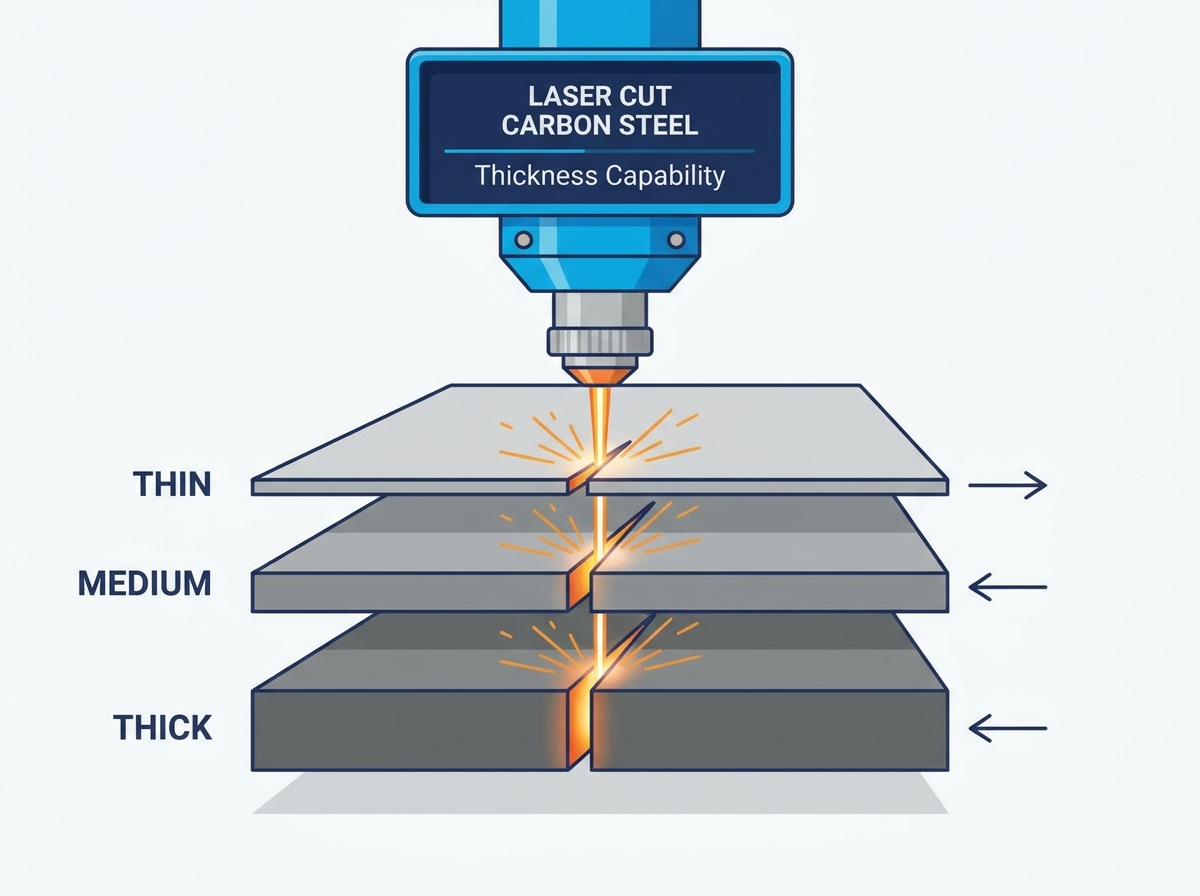
The assist gas affects cutting performance, edge condition, and total processing cost. It should be selected according to the finished part's requirements.
Oxygen reacts with heated steel and generates additional heat. This reaction helps support cutting thicker carbon steel under suitable conditions.
Potential advantages include:
Effective cutting of carbon steel plate across a range of thicknesses.
Reduced reliance on laser energy alone to sustain the cutting process.
Suitability for applications where an oxidized edge is acceptable or can be removed during finishing.
The main trade-off is that oxygen cutting creates an oxide layer on the cut edge. If the part will be welded or coated, the required surface preparation should be included in the production plan.
Nitrogen is commonly used when oxidation must be reduced. It helps remove molten material while limiting the reaction between the hot steel and oxygen in the surrounding air.
Potential advantages include:
Less oxidation on the cut edge under suitable conditions.
Reduced oxide-removal work for applications that require a clean edge.
Potential benefits for downstream finishing when the process is properly specified.
Nitrogen cutting can require high gas flow and pressure. On thick carbon steel, the achievable thickness and economic benefit must be confirmed for the specific machine.
Filtered, dry compressed air may be an option for some thinner carbon steel applications. Its suitability depends on laser power, air quality, cutting parameters, and the acceptable level of oxidation.
Air should not be assumed to match the performance of oxygen or nitrogen across all thicknesses. Test the actual material and part requirements before selecting it for production.
Assist gas | Main process characteristic | Main consideration |
|---|---|---|
Oxygen | Adds heat through an oxidation reaction | Oxide removal may be needed |
Nitrogen | Helps limit oxidation at the cut edge | Gas consumption and achievable thickness |
Compressed air | Uses a readily available gas mixture | Air quality and edge-finish requirements |

Two different limits matter when evaluating a fiber laser.
Maximum severance thickness is the greatest thickness a machine can separate under specific conditions. The resulting edge may require substantial cleanup, and cutting speed may be too slow for regular production.
Practical production thickness is the thickness the machine can process repeatedly while meeting the required edge quality, dimensional tolerance, cycle time, and cost target.
The second figure is usually more useful for equipment selection.
Before accepting a maximum-thickness claim, ask the supplier for details about:
The exact steel grade and plate thickness.
The assist gas, gas pressure, and required flow rate.
Cutting speed and piercing method.
Edge taper, dross, and surface condition.
Dimensional tolerance and repeatability.
The amount of deburring or other post-processing required.
Requesting a sample cut using your own material and drawing is more reliable than comparing headline specifications alone.
As thickness increases, maintaining a stable cut can become more challenging. Several issues deserve attention during process validation.
Dross is material that resolidifies along the cut edge, often near the bottom of the plate. It can result from unsuitable cutting parameters, ineffective melt removal, or operation outside the machine's stable process range.
Heavy dross may require grinding or deburring. Include this labor in the cost-per-part calculation.
Striations are lines visible on the cut surface. Their appearance depends on the cutting process and may become more pronounced when the process is not well matched to the material thickness.
If the edge is used for precision assembly or further machining, evaluate the finished surface against the drawing and quality requirements.
The laser beam and cutting process can produce a cut face that is not perfectly perpendicular to the plate surface. Taper and dimensional variation may become more important on thicker material.
If the parts contain precision slots, interlocking features, or close-fitting components, test the actual geometry rather than relying only on the machine's positioning accuracy.
For more detail on dimensional performance, see DINGPRECISION's Laser Cutting Tolerance Guide.
A higher-power machine may improve throughput, but it can also require greater investment and supporting infrastructure. Evaluate the complete process rather than the laser source alone.
Important cost factors include:
Electricity and cooling: Check the machine's electrical requirements and cooling capacity.
Assist gas: Estimate gas consumption and supply costs at the intended thickness and production volume.
Consumables and maintenance: Include nozzles, protective windows, optics inspections, and routine servicing.
Operator experience: Stable thick-plate cutting depends on correct parameter selection and process monitoring.
Secondary processing: Account for grinding, oxide removal, machining, inspection, and scrap.
Machine utilization: A high-power system may not be economical if thick-plate jobs are infrequent.
The most useful comparison is total cost per accepted part, including machine time, gas, labor, maintenance, and finishing.
Fiber laser cutting is not automatically the best choice for every thick-plate job.
Plasma cutting may be worth comparing for thicker structural parts when the required tolerance and edge finish can be achieved economically. Actual suitability depends on plate thickness, part geometry, quality requirements, and production volume.
Waterjet cutting may be suitable when the application places strict limits on heat-related changes or when the material is not suitable for thermal cutting. It can also be useful for some materials and geometries that are difficult to process with a laser.
Compare technologies using the same part drawing, material, tolerance, production quantity, and finishing requirements. The lowest machine cutting time does not always produce the lowest finished-part cost.
Use the following checklist before selecting a machine or manufacturing supplier:
Identify the carbon steel grade and the full range of plate thicknesses.
Define the required tolerance and acceptable cut-edge condition.
Confirm whether oxide-free edges are necessary for welding, coating, or assembly.
Request verified cutting data for the exact machine and assist gas.
Run a sample cut and inspect dross, taper, roughness, and dimensional accuracy.
Compare gas, electricity, consumables, labor, and finishing costs.
Confirm that the supplier can meet your production volume consistently.
For OEM and sheet metal projects, DINGPRECISION provides laser cutting and integrated sheet metal fabrication services. Share your drawing, material grade, thickness, and quality requirements to confirm process feasibility and request a project-specific quotation through the official contact page.
How thick a fiber laser can cut carbon steel depends on more than laser wattage. Material grade, assist gas, machine configuration, edge quality, and production requirements all affect the practical limit.
The maximum thickness advertised for a machine should be treated as a starting point, not a production guarantee. To make a sound decision, validate the process using your actual material and part requirements, then compare the total cost per accepted part.
There is no universal maximum. Cutting thickness depends on laser power, machine design, steel grade, assist gas, and required edge quality. Confirm the specific machine's cutting chart and request a sample cut.
Oxygen is commonly used for carbon steel because its reaction with heated steel adds energy to the process. Nitrogen may be chosen when reduced oxidation is important. The best choice depends on thickness, finish requirements, and operating cost.
Maximum thickness usually refers to the greatest thickness a machine can separate under specified conditions. Production thickness is the range it can cut consistently at the required quality, speed, and cost.
Dross forms when molten material is not removed cleanly and resolidifies along the cut edge. Cutting parameters, assist-gas conditions, material surface, and machine capability can all contribute.
Provide the steel grade, thickness, drawing, tolerance, edge-finish requirements, and production volume. Ask for verified process data and a sample cut, then evaluate quality and total processing cost.
Request a Custom IP-Rated Enclosure Quote
Phone: +1 0757-26630312
Email: niewenhui@dingprecision.com
Website: www.dingprecision.com


