
Views: 0 Author: Site Editor Publish Time: 2026-11-20 Origin: Site


Choosing between stainless steel and carbon steel affects product cost, corrosion resistance, fabrication requirements, and service life. The right choice depends on the operating environment, mechanical requirements, surface finish, and production budget.
Carbon steel is often a cost-effective option for sheet metal parts that will receive protective coatings. Stainless steel is suitable when the application requires inherent corrosion resistance or a specific appearance. However, neither material is the best choice for every project.
This guide compares stainless steel vs. carbon steel for sheet metal fabrication. It explains their main properties, fabrication differences, common applications, and key factors to review before specifying a material.
Table of Contents
Factor | Carbon Steel | Stainless Steel |
|---|---|---|
Initial material cost | Generally lower | Generally higher |
Corrosion resistance | Usually requires protective treatment | Generally better due to chromium content |
Formability | Low-carbon grades are often easy to form | Depends on grade, thickness, and forming conditions |
Bending | Usually predictable with suitable tooling | May require adjustments for forming force and springback |
Welding | Generally good for common low-carbon grades | Requires grade-appropriate procedures and heat control |
Surface finish | Often needs painting, powder coating, or plating | Available in multiple finishes; coating may still be required |
Magnetic response | Usually magnetic | Depends on the stainless steel family and processing |
Common applications | Brackets, frames, enclosures, and chassis | Corrosion-exposed parts, visible panels, and hygiene-sensitive equipment |
The exact performance of each material depends on its grade, thickness, processing history, and service conditions. Use the table as an initial guide rather than a substitute for engineering review.
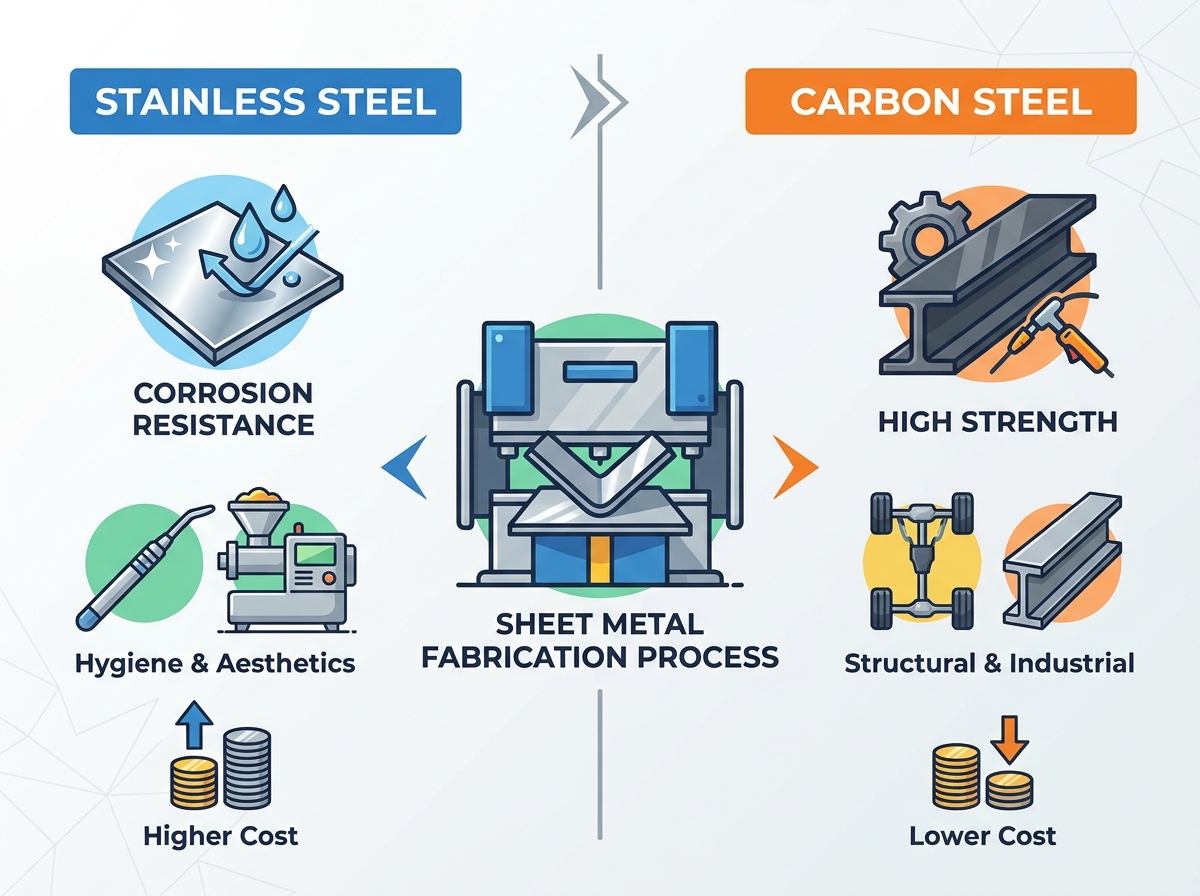
Carbon steel is primarily an iron-carbon alloy. Its properties vary with carbon content, grade, heat treatment, and manufacturing process. Low-carbon grades are widely used in sheet metal fabrication because they generally offer good formability, weldability, and material economy.
Common options include:
1008 and similar low-carbon grades: Often selected for drawing and forming operations that require good ductility.
1018: Used for general engineering components where its specified mechanical properties suit the design.
A36: A structural steel grade commonly associated with structural shapes and plates. Confirm product form and applicable specifications before using it as a thin-sheet substitute.
Carbon steel does not have the same inherent corrosion resistance as stainless steel. In humid, outdoor, or chemically exposed environments, it may require galvanizing, plating, painting, or powder coating.
For indoor enclosures, brackets, machine frames, and other parts that can be protected with a suitable finish, carbon steel can provide a practical balance of cost and performance.
Stainless steel contains at least 10.5% chromium by mass. Chromium helps form a passive surface layer that improves corrosion resistance. This layer can reform under suitable conditions, but stainless steel can still corrode in aggressive environments.
Common sheet metal grades include:
304 stainless steel: A widely used austenitic grade for general corrosion resistance, formed components, equipment panels, and many indoor applications.
316 stainless steel: Contains molybdenum and generally offers improved resistance to chloride-related pitting compared with 304. It is often considered for coastal, marine, and chemical-exposure applications.
430 stainless steel: A ferritic grade used in some indoor appliances, decorative panels, and applications where its properties and corrosion resistance are sufficient.
Grade selection should reflect the actual environment, cleaning chemicals, temperature, surface condition, and expected service life. For demanding chloride exposure, 316 may be a better candidate than 304, but the final choice still requires application-specific evaluation.
For a broader comparison of available sheet materials, see the DINGPRECISION material selection guide.
Low-carbon steel is commonly used for parts that require repeated bends or relatively complex shapes. Its formability depends on the grade, thickness, rolling condition, bend radius, and tooling setup.
Stainless steel may require different bending settings because its strength, work-hardening behavior, and springback can differ from those of low-carbon steel. The required press brake force is not governed by one universal percentage. It must be evaluated using the material grade, thickness, bend length, tooling, and forming method.
To reduce cracking and dimensional variation:
Confirm the material grade and thickness before production.
Specify an appropriate inside bend radius.
Review grain direction where it affects forming quality.
Account for springback during tooling setup.
Validate critical dimensions on first articles.

Material selection also affects achievable dimensions and tolerances. Review the drawing and process requirements with your fabrication partner before finalizing a design. See the sheet metal tolerance standards guide for additional design considerations.
Both carbon steel and stainless steel can be laser cut, but the cutting parameters and assist gas may differ.
Oxygen is commonly used for cutting carbon steel because the reaction between oxygen and hot metal can support the cutting process. Depending on the application, the cut edge may have oxidation that needs to be addressed before painting or welding.
Nitrogen is often used when cutting stainless steel to produce a cleaner edge with less oxidation. The best gas, pressure, power, and speed depend on the material grade, thickness, required edge quality, and cutting equipment.
Do not assume that one set of parameters works for every grade or thickness. Confirm process capability and downstream finishing requirements before production.
Low-carbon steel is generally suitable for common MIG and TIG welding processes when the grade, joint design, and procedure are appropriate.
Stainless steel requires attention to heat input, distortion, filler material, and corrosion performance. Some stainless grades have lower thermal conductivity and higher thermal expansion than carbon steel. These differences can increase local heat concentration and distortion during welding.
Good process planning may include suitable fixturing, controlled welding sequences, and appropriate filler materials. For stainless steel parts exposed to corrosive environments, remove weld discoloration and contamination using a suitable finishing procedure. Passivation may be appropriate for some applications, but the required post-weld treatment should be specified according to the grade and service conditions.
Welding dissimilar metals, such as stainless steel to carbon steel, is possible with an appropriate procedure and filler material. The joint design and surrounding environment must also be assessed for corrosion risks.
Surface finishing is a major factor in the total cost of a fabricated part.
Carbon steel commonly requires a protective finish when exposed to moisture or corrosive conditions. Options include galvanizing, plating, wet painting, and powder coating. The suitable method depends on the environment, appearance requirements, part geometry, and expected service life.
Stainless steel can often be used without a decorative coating because of its inherent corrosion resistance. It is also available in finishes such as brushed, polished, and mill finish. However, the surface must still be specified and handled properly. Contamination, unsuitable cleaning chemicals, crevices, and chloride exposure can affect performance.
When stainless steel and carbon steel are processed in the same facility, use appropriate controls to reduce free-iron contamination on stainless surfaces. Dedicated abrasives and suitable cleaning procedures can help reduce the risk of rust spots caused by embedded carbon steel particles.
For projects that need a protective coating, review DINGPRECISION's sheet metal fabrication services to understand its available cutting, forming, welding, and surface treatment processes.

Carbon steel is often a suitable choice for:
Indoor electrical cabinets and equipment enclosures.
Structural brackets, frames, and mounting plates.
Machine housings and internal support components.
Parts that will receive a suitable protective coating.
Projects where the required mechanical properties can be met at a lower material cost.
For outdoor use, evaluate the coating system, edge coverage, drainage, fasteners, and maintenance requirements. A coated carbon steel part may be suitable for many environments, but its durability depends on the complete protection system.
Stainless steel may be appropriate for:
Equipment exposed to moisture or frequent cleaning.
Visible panels where a metallic finish is required.
Components used in certain food-processing or hygiene-sensitive environments.
Parts exposed to selected chemicals or chloride-containing environments.
Applications where coating damage would create unacceptable maintenance risks.
Choose the grade according to the actual exposure. Grade 304 suits many general applications, while 316 may provide better resistance in some chloride-rich environments. Neither grade should be treated as universally corrosion-proof.
For regulated applications, verify the relevant material, surface, and product requirements. A material grade alone does not establish compliance with every food-contact, medical, or sanitary standard.
Before approving a material for production, review these five factors:
Operating environment: Identify exposure to moisture, salt, chemicals, temperature changes, and cleaning agents.
Mechanical requirements: Confirm load, stiffness, strength, impact resistance, and dimensional stability.
Fabrication requirements: Review bend radii, hole positions, welding, hardware installation, and tolerance requirements.
Surface finish: Decide whether the part needs powder coating, painting, polishing, brushing, or another finish.
Total cost: Compare raw material cost with finishing, fabrication, inspection, maintenance, and expected service life.
The lowest material price does not always produce the lowest total cost. Conversely, specifying stainless steel for a protected indoor component may increase cost without providing a meaningful benefit.
A design-for-manufacturing review can help balance material performance, fabrication capability, and budget before production begins.
Carbon steel and stainless steel both have important roles in sheet metal fabrication. Carbon steel is often economical and formable, especially when a suitable protective finish is available. Stainless steel offers inherent corrosion resistance and a range of surface finishes, but grade selection and fabrication controls remain important.
The best material depends on the product's environment, mechanical requirements, manufacturing process, appearance, and lifecycle cost. Confirm these factors with your fabrication partner before releasing the final drawing.
If you need help evaluating material and manufacturing requirements for a custom part, contact DINGPRECISION to discuss your drawings and project specifications.
Neither material is universally better. Stainless steel is often preferred for corrosion resistance and appearance, while carbon steel is often selected for cost-effective, formable parts that can receive protective coatings.
It can be. The required force and springback depend on the specific grades, thicknesses, bend radii, tooling, and forming conditions. Fabricators should calculate the required force and validate critical bends.
No. The requirement depends on the operating environment and expected service life. However, carbon steel generally needs suitable corrosion protection when exposed to moisture or corrosive conditions.
Grade 304 is widely used for general corrosion resistance. Grade 316 generally provides better resistance to chloride-related pitting. The correct grade depends on the actual environment, chemical exposure, temperature, and maintenance requirements.
Carbon steel usually has a lower initial material cost. Stainless steel may offer lower lifecycle costs in applications where corrosion resistance reduces coating, maintenance, or replacement needs. Compare the full cost of the finished part rather than raw material prices alone.
Request a Custom IP-Rated Enclosure Quote
Phone: +1 0757-26630312
Email: niewenhui@dingprecision.com
Website: www.dingprecision.com


