
Views: 0 Author: Site Editor Publish Time: 2025-10-15 Origin: Site


State Grid of Saudi Arabia requires 17.5kV ring network cabinet
Saudi State Grid requires 17.5kV ring network cabinets with the following typical features:
@ Outdoor box;
@ Has a separate cable withstand voltage test end compartment;
@ Use self-powered protection unit;
@SF6 Cabinet-type F+F+V (load switch + load switch + circuit breaker) configuration;
@The ring network switch unit has a rated current of 630A, and the outgoing circuit breaker has a rated current of 200A.
@ Refer to standard 32-SDMS-11 for implementation.

According to reference materials, the rated short-time withstand current should be selected from the R10 series specified in GB762, and must equal the short-circuit ratings of switchgear and control equipment. For the State Grid Standard Ring Main Unit (RMMU) in Saudi Arabia, the rated voltage is 13.8kV, the equipment's rated voltage is 17.5kV, and the rated frequency is 60Hz. The rated short-time withstand current is 21kA sustained for one second, while the peak withstand current should be 2.5 times this value, i.e., 21kA * 2.5 = 52.5kA. Therefore, the original text's calculation of the peak withstand current as 21kA * 2.6 = 54.6kA slightly deviates from the standard calculation method.
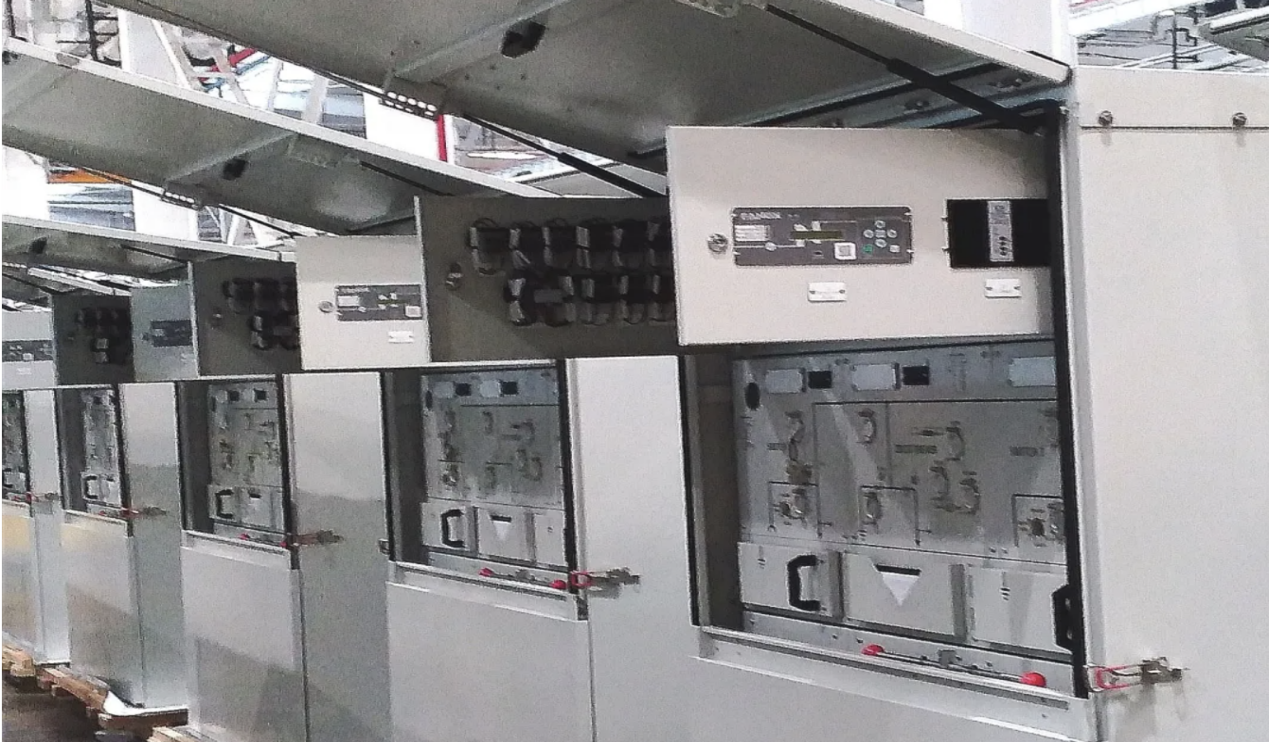
The SF6 insulated co-box structure is adopted, and the protection class reaches IP54 standard. It can be directly used in outdoor environment. The upward flip cover structure is adopted to facilitate secondary control and protection operation.
Due to the outdoor enclosure installation method and the requirement for meter rooms, switchgear height should not be excessively large. In China, the common three-position switchgear combined with upper/lower circuit breaker cabinets results in significant height issues. To meet Saudi State Grid's requirements for low-profile products, adopting a left/right horizontal layout configuration of three-position switches and vacuum circuit breakers can effectively reduce the overall height.
State Grid's technical specifications for the width allow for greater flexibility. Compared to the standard Chinese 350+350+350mm=1050mm configuration, the requirement can be moderately relaxed, with a maximum overall width of 1.5 meters being acceptable. For design purposes, it is recommended to use the LUCI switchgear dimensions as a reference.
The three-position switch and the arc extinguishing chamber of the vacuum circuit breaker are arranged horizontally side by side, as shown in the figure below.

For load switch units, the cable withstand voltage test terminal is designed as follows: Given the compact size of sulfur hexafluoride (SF6) load switches and the larger dimensions of standard gas-insulated switchgear cabinets, the three-limit switch's grounding contact is connected via a copper rod to the front bushing of the switchgear enclosure. During testing, the load switch remains in the closed position. The test terminal is connected to high-voltage testing equipment, allowing direct application of high voltage to evaluate the cable's insulation performance.
After the test is completed, remove the test equipment, connect the shorting plate for grounding, make the grounding switch back to the grounding state, close the compartment door, and then operate the grounding switch to open, so as to realize the normal function of the three-position switch.
In order to ensure that the copper busbar can meet the closing capacity and dynamic thermal stability of the grounding switch under the action of short-circuit current, the copper busbar must have a large enough cross-sectional area to withstand at least 1 second of 21kA thermal stability current, so as to avoid the risk of burnout caused by too small cross-sectional area.
For passive microprocessor-based protection systems similar to WIC1-type devices, low-energy tripping coils are employed to control circuit breaker opening operations. Specifically, when external power supply failure triggers short-circuit currents exceeding trip thresholds, the passive protection system generates electromagnetic signals that activate the low-energy tripping coil's main shaft, thereby achieving circuit breaker disconnection.

Additionally, the enclosure features integrated protection through a unified design approach. Rather than using separate ring main units (RMUs) and outdoor cabinets, the system combines the outer casing with the RMU as an integrated unit. The cable compartment serves as part of the casing structure, meeting strict sealing and waterproofing requirements. The top-mounted flip cover allows easy access to switch statuses, microprocessor-based protection devices, secondary circuit conditions, and maintenance inspections.
The system employs an integrated power supply voltage transformer (VT) configuration, where the transformer directly powers the battery. The battery then supplies power to the secondary control circuit and circuit breaker operation circuit through the power module, eliminating the need for external power sources. The secondary control and status circuits utilize communication protocols, enabling seamless management with external backend systems through a single wire connection.


